
Tag

finality of decree
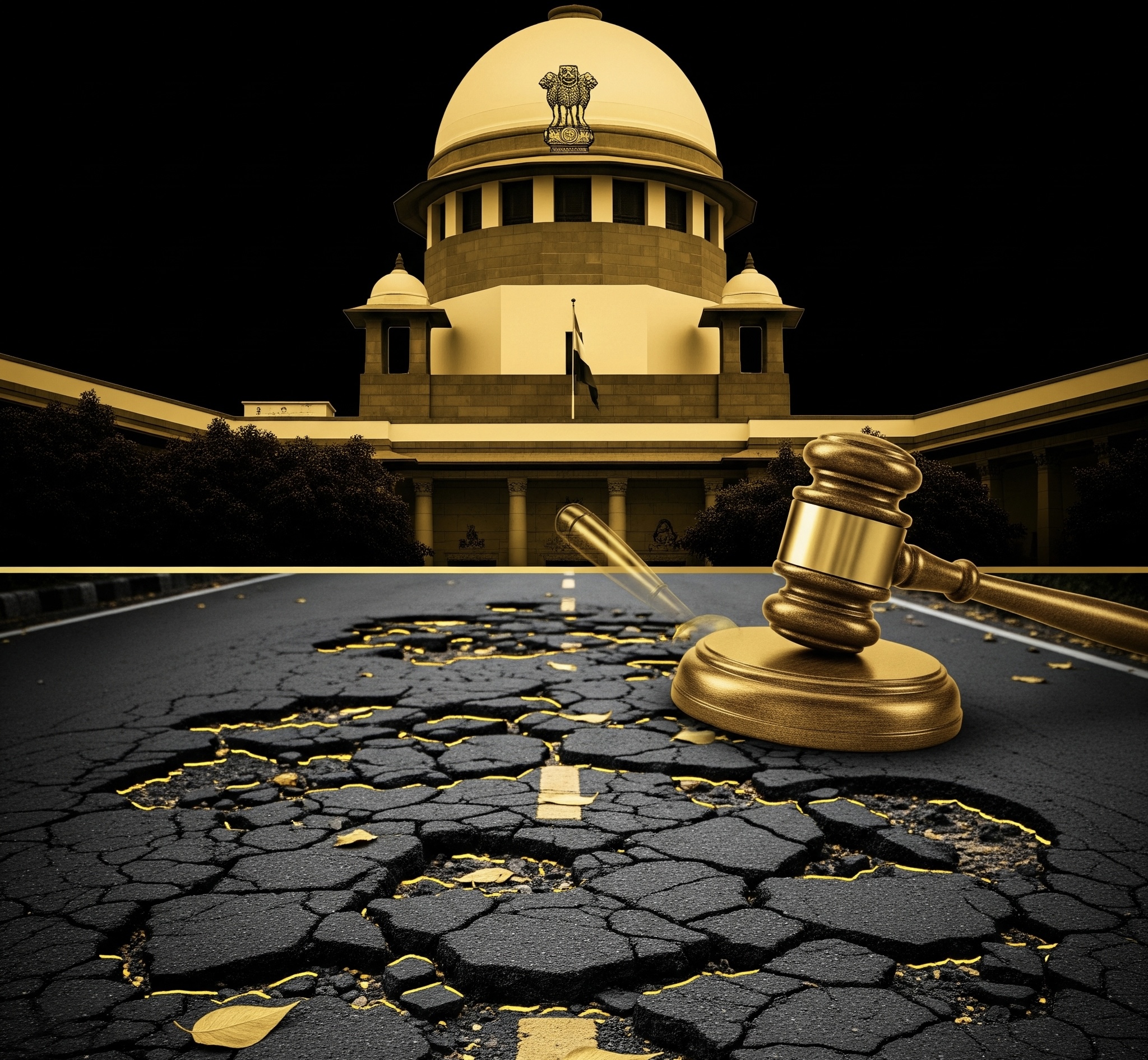
Supreme Court Upholds Kerala HC: Citizens Need Not Pay Toll for Damaged Highways
20
Aug

Supreme Court Upholds Kerala HC: Citizens Need Not Pay Toll for Damaged Highways

Case: National Highway Authority of India and Anr. v. O.J Janeesh and Ors.
Court: Supreme Court of India
Date of Judgment: 18 July 2025
Coram: Hon’ble CJI BR Gavai and Justice K. Vinod Chandran
Citation: 2025 LiveLaw (SC) 819

Summary

The Supreme Court has ruled that the National Highways Authority of India (NHAI) cannot force commuters to pay toll fees if the highway is not maintained in a motorable condition. Upholding the Kerala High Court’s suspension of toll collection at the Paliyekkara toll plaza on NH-544, the Court affirmed that the obligation to pay toll carries with it a corresponding right to safe and unhindered roads.

Background

  • The dispute arose from the Edapally–Mannuthy stretch of NH-544 in Thrissur, Kerala.
  • Due to delays in road works, the highway was in severe disrepair, causing massive traffic congestion, including a 12-hour traffic jam reported in August 2025.
  • Citizens challenged the levy of toll despite the poor condition of the road.
  • On August 6, 2025, the Kerala High Court suspended toll collection for four weeks, holding that toll cannot be demanded when access to the highway is hindered.
  • NHAI and the concessionaire appealed to the Supreme Court.

Key Issues

  • Citizens’ stance: Paying toll for unsafe and congested roads is unfair and violates the principle of public trust.
  • NHAI’s stance: Toll collection is permitted under statutory provisions regardless of temporary inconveniences.
  • Concessionaire’s stance: Suspension of toll causes financial loss and affects contractual obligations.

Supreme Court Findings

1. Right to safe access:

Citizens paying toll are entitled to safe, unhindered, and regulated access to highways.

2. Poor roads = no toll:

If the NHAI or its concessionaire fails to maintain roads, toll collection cannot continue.

3. Agreement with Kerala HC:

The SC expressly endorsed the High Court’s reasoning that toll collection is tied to a reciprocal duty of providing motorable roads.

Cited Precedents

  • The judgment reinforced principles of public trust doctrine and citizen rights in toll collection.
  • Relied on the Kerala High Court’s earlier rulings on toll-road maintenance obligations.

Important Observations

  • “The toll is really on the purse and the patience of the citizen, as also the environment.”
  • “Citizens who have already paid tax should not be forced to pay further to navigate potholes, gutters, and inefficiency.”
  • “Why should a person pay ₹150 if it takes 12 hours to cross a road meant to take 1 hour?” – CJI Gavai.

This ruling is a strong affirmation of citizens’ rights against arbitrary toll collection. It reinforces that infrastructure contracts cannot override public trust, and the state and its agencies have a constitutional duty to maintain roads. While concessionaires’ financial concerns are genuine, they cannot override commuters’ safety and convenience.

Outcome

  • NHAI’s appeal dismissed.
  • Toll collection at Paliyekkara remains suspended until roads are repaired.
  • Concessionaire may seek relief only after resumption of smooth traffic.

Final Thoughts

This ruling will be crucial in strengthening accountability of infrastructure authorities across India. It sets a precedent that toll collection is not a blanket right but a conditional obligation tied to road quality and safety. Citizens now have a judicially upheld right to demand good roads in return for toll payments.

SOURCE: LiveLaw

Bhavika Singh

Bhavika Singh

Supreme Court: Entire Appeal Abates If Legal Heirs of Deceased Party in Joint Decree Not Substituted
08
Aug

Supreme Court: Entire Appeal Abates If Legal Heirs of Deceased Party in Joint Decree Not Substituted

Case: Suresh Chandra (Deceased) through LRs & Ors. v. Parasram & Ors.
Court: Supreme Court of India
Date of Judgment: 18 July 2025
Coram: Hon’ble Justices P.S. Narasimha and Manoj Misra
Citation: 2025 LiveLaw (SC) 728

Summary

The Supreme Court held that in cases involving a joint and indivisible decree, failure to substitute the legal representatives of a deceased party in time leads to complete abatement of the appeal under Order XXII Rule 3 of the Code of Civil Procedure (CPC). The Court explained that continuing the appeal only against the surviving parties would risk conflicting or inconsistent decrees, which is impermissible.

Background

  • The original suit was filed in 1983 by Parasram seeking declaration of ownership, possession, and mesne profits of a house.
  • The defendants, Suresh Chandra and Ram Babu, denied the tenancy claim and jointly asserted ownership through inheritance from their father via a 1947 partition.
  • The Trial Court dismissed the suit, but the First Appellate Court reversed it in favour of the plaintiff.
  • A second appeal was filed by Suresh Chandra’s LRs and Ram Babu.
  • During the pendency of the appeal, Ram Babu passed away in 2015, and his legal heirs were not substituted.
  • In 2022, the High Court declared the entire second appeal abated due to this lapse.
  • The LRs of Suresh Chandra appealed to the Supreme Court.

Key Arguments

  • The appellants argued that the appeal should not have abated in its entirety and could have proceeded against the surviving defendant.
  • They contended that the rights and liabilities were severable between the two defendants.

Supreme Court Findings

1. Appeal Cannot Be Partially Continued

The Court ruled that the decree passed by the First Appellate Court was joint and inseparable, based on a common claim of ownership by both defendants. Therefore, the appeal could not proceed only against one, as it would lead to an inconsistent decree.

2. Finality of Decree Against Deceased Party

Once legal representatives of Ram Babu were not brought on record, the decree against him attained finality, and further proceedings would result in conflicting outcomes.

3. Abatement Applies to Entire Appeal

In such joint and indivisible claims, abatement in respect of one party is fatal to the entire appeal.


Cited Precedents

  • Sardar Amarjit Singh Kalra (Dead) by LRs v. Pramod Gupta (Smt.) (Dead) by LRs, (2003) 3 SCC 272
  • Other key legal principles drawn from Order XXII Rule 3 of CPC

Important Observations

  • The nature of the decree (whether joint and inseverable or severable) is key to determining the effect of non-substitution of LRs.
  • A joint claim based on shared ownership or right, if decreed against the defendants collectively, leads to indivisibility of the decree.
  • Inconsistent decrees are those that are mutually self-destructive, where the enforcement of one negates the other.
  • Courts must avoid scenarios where finality of part of a judgment compromises the fairness and enforceability of the rest.

This judgment has significant implications for civil appellate practice. It reiterates the importance of promptly substituting legal heirs, particularly in joint decree matters. Litigants and lawyers alike must appreciate the procedural rigour involved in maintaining appeals. A lapse as simple as non-substitution can undo years of litigation, even if the merits favour the appellant.

Outcome

The Supreme Court upheld the High Court’s decision and dismissed the appeal in its entirety, citing the risk of inconsistent and unenforceable decrees.

Final Thoughts

This ruling will be crucial for civil litigators, estate lawyers, and parties in joint ownership disputes. It reinforces the finality and integrity of joint decrees and the vital importance of procedural compliance in substitution of legal representatives. Failure to act promptly can result in complete abatement and loss of appellate remedies, regardless of the strength of the claim.

SOURCE: LiveLaw

Bhavika Singh
Bhavika Singh