Tag

Supreme Court
Once Rejected, Anticipatory Bail Cannot Be Revived by Recall: Supreme Court
19
Sep

Once Rejected, Anticipatory Bail Cannot Be Revived by Recall: Supreme Court

Case: Gurvinder Singh v. Jasbir Singh @ Jasvir Singh & Anr.
Court: Supreme Court of India
Date of Judgment: 15 September 2025
Coram: Hon’ble Justices Ahsanuddin Amanullah and SVN Bhatti
Citation: 2025 LiveLaw (SC) 924

Summary

The Supreme Court set aside the Punjab & Haryana High Court’s order recalling its earlier decision dismissing an anticipatory bail plea. It held that once an anticipatory bail plea has been rejected, the proceedings attain finality and cannot be revived through recall or restoration.

Background

  • Respondent No.1 was accused of offences under Sections 406, 420, and 120-B IPC.
  • He applied for anticipatory bail before the Punjab & Haryana High Court.
  • On 17 January 2025, the High Court dismissed the plea.
  • On a later petition, the High Court recalled the dismissal order and granted anticipatory bail on 7 February 2025.
  • The complainant challenged this recall before the Supreme Court.

Key Issues

  • The complainant argued that once anticipatory bail is dismissed, the proceedings cannot be reopened.
  • The accused/respondent defended the recall order, claiming cogent reasons were recorded by the High Court.

Supreme Court Findings

  • Finality of Orders: Once an anticipatory bail plea is rejected, proceedings are concluded.
  • No Recall Power: The High Court could not have revived or restored the dismissed plea.
  • Error in Granting Bail: Granting anticipatory bail after recall was legally impermissible.

Cited Precedents

  • While the judgment does not reference specific precedents, it reinforces the established principle of finality of judicial orders and the bar against review/recall in criminal proceedings except as permitted by law.

Important Observations

  • The High Court’s action was “a course unknown in law.”
  • Restoration of a dismissed anticipatory bail petition undermines the certainty and stability of judicial orders.
  • Judicial discipline requires strict adherence to the principle that once rejected, such applications cannot be reopened.

This ruling strengthens the principle of judicial finality, ensuring consistency and certainty in criminal proceedings. The Supreme Court has rightly cautioned against procedural overreach, as allowing recall in such cases could open doors to endless litigation and forum shopping.

Outcome

  • The Supreme Court set aside the High Court’s order dated 07.02.2025.
  • The original order dismissing the anticipatory bail plea dated 17.01.2025 was revived.
  • Appeal allowed.

Final Thoughts

This ruling will be crucial for reinforcing the doctrine of finality in bail proceedings, ensuring that once anticipatory bail is rejected, litigants cannot re-approach courts under the guise of recall, thereby safeguarding judicial discipline and preventing misuse of process.

SOURCE: LiveLaw

Bhavika Singh

Bhavika Singh

Supreme Court: Bail & Anticipatory Bail Applications Must Be Disposed Within Two Months
13
Sep

Supreme Court: Bail & Anticipatory Bail Applications Must Be Disposed Within Two Months

Case: Anna Waman Bhalerao v. State of Maharashtra
Court: Supreme Court of India
Date of Judgment: 12 September 2025
Coram: Hon’ble Justices JB Pardiwala and R. Mahadevan
Citation: 2025 LiveLaw (SC) 901

Summary

The Supreme Court directed all High Courts and subordinate courts to dispose of bail and anticipatory bail applications expeditiously, preferably within two months, to safeguard the fundamental right to liberty. The Court criticized the long pendency of such applications, highlighting that delays amount to a denial of justice under Articles 14 and 21 of the Constitution.

Background

The case arose from an anticipatory bail plea filed in 2019 by three accused charged with forgery and illegal land transfer under Sections 420, 463, 464, 465, 467, 468, 471, and 474 read with Section 34 IPC. The Bombay High Court kept the applications pending for nearly six years before rejecting them. The accused challenged the prolonged pendency before the Supreme Court.

Key Issues

  • The accused were booked for forgery and illegal transfer of land.
  • They alleged that the High Court’s six-year delay in deciding their anticipatory bail applications violated their right to personal liberty.

Supreme Court Findings

  • Bail and anticipatory bail applications directly affect personal liberty and cannot remain pending indefinitely.
  • Prolonged delays defeat the object of CrPC and violate constitutional rights.
  • Bail adjudication is generally straightforward and should not languish due to docket burden.
  • High Courts must create mechanisms to prevent backlog of bail cases.
  • While upholding the Bombay HC’s rejection of anticipatory bail, the SC criticized the inordinate delay and allowed the appellants to apply for regular bail upon arrest.

Cited Precedents

  • The Court reiterated principles from earlier rulings emphasizing the need for expeditious disposal of bail-related cases in line with constitutional guarantees of liberty.

Important Observations

  • “Applications concerning personal liberty cannot be kept pending for years.”
  • “In matters concerning liberty, bail courts must be sensitive and ensure that constitutional ethos is upheld.”
  • The pendency of bail matters directly undermines Articles 14 and 21.

This judgment is a reminder that judicial delays, especially in bail matters, undermine fundamental rights. Courts must prioritize liberty over docket pressure, and the directive to decide bail applications within two months will bring much-needed accountability.

Outcome

  • Appeals dismissed, affirming Bombay HC’s rejection of anticipatory bail.
  • Appellants permitted to seek regular bail after arrest.
  • Mandatory directive to High Courts and subordinate courts: bail/anticipatory bail applications must be decided preferably within two months.

Final Thoughts

This ruling will be crucial in ensuring that bail and anticipatory bail matters do not linger indefinitely, thereby protecting citizens’ constitutional rights to liberty and fair process. It marks a strong judicial stance that personal liberty must not be compromised by procedural delays.

SOURCE: LiveLaw

Adv. Neeraj Kumar Garg

SC: Denying Regularization While Granting It to Similarly Placed Workers Violates Equity
05
Sep

SC: Denying Regularization While Granting It to Similarly Placed Workers Violates Equity

Case: Dharam Singh & Ors. v. State of U.P. & Anr.
Court: Supreme Court of India
Date of Judgment: 19 August 2025
Coram: Hon’ble Justices Vikram Nath & Sandeep Mehta
Citation: 2025 INSC 998; 2025 LiveLaw (SC) 818

Summary

The Supreme Court ruled that denying regularization to daily wage employees engaged in perennial work while regularizing others in the same establishment amounts to unconstitutional discrimination. The Court directed the immediate regularization of appellants with retrospective effect from 2002, creation of supernumerary posts where necessary, and full financial benefits including arrears, pension recalculations, and compliance affidavits.

Background

  • Appellants were engaged between 1989–1992 as Class-IV employees (Peon/Attendant) and one Driver.
  • They worked continuously as daily wagers, later on consolidated pay.
  • The Commission acknowledged their need and sought post sanction multiple times (1991, 1997, 1999), but the State rejected citing financial constraints and a ban on new posts.
  • In 2000, appellants challenged the refusal before the Allahabad High Court.
  • Single Judge and Division Bench dismissed the pleas, relying on Umadevi and absence of sanctioned vacancies.
  • The matter reached the Supreme Court in appeal.

Key Issues

  • State arbitrarily refused to sanction posts despite perennial work.
  • Similarly situated daily wagers had been regularized while appellants were denied.
  • High Court wrongly treated the case as a simple plea for regularization instead of challenging State’s refusal.

Supreme Court Findings

  • State’s Refusal Unsustainable – Non-speaking rejections citing financial strain were arbitrary and unreasonable.
  • Perennial Work Established – Continuous duties like dispatch, application scrutiny, and driving proved the work was permanent.
  • Vacancies Existed – RTI responses and unrebutted claims showed available Class-III and IV posts.
  • Discrimination in Regularization – Selective absorption of others while denying appellants violated equity under Articles 14, 16, and 21.
  • Misapplication of Umadevi – The case was about arbitrary refusal, not illegal appointments.
  • Outsourcing Cannot Justify Denial – Future outsourcing policies cannot erase accrued rights.
  • State as Constitutional Employer – Financial constraints are not a justification to deny fairness and dignity to workers.


Cited Precedents

  • Secretary, State of Karnataka v. Umadevi (2006) 4 SCC 1 – distinguished.
  • Jaggo v. Union of India (2024 SCC OnLine SC 3826).
  • Shripal v. Nagar Nigam, Ghaziabad (2025 SCC OnLine SC 221).

Important Observations

  • “Selective regularisation in the same establishment, while continuing the appellants on daily wages despite comparable tenure and duties with those regularized, is a clear violation of equity.”
  • “Financial stringency is not a talisman that overrides fairness, reason, and the duty to organise work on lawful lines.”
  • “Sensitivity to the human consequences of prolonged insecurity is not sentimentality. It is constitutional discipline.”

This judgment reaffirms that the State, as a model employer, cannot hide behind financial excuses or outsourcing to perpetuate exploitative ad-hocism. The recognition of workers’ rights as constitutional obligations under Articles 14, 16, and 21 sets a strong precedent against precarious employment.

Outcome

  • Appellants directed to be regularized from 24.04.2002.
  • Supernumerary posts to be created if sanctioned posts unavailable.
  • Arrears, continuity of service, pension recalculations, and benefits ordered.
  • Compliance affidavit to be filed within 4 months.

Final Thoughts

This ruling will be crucial for thousands of daily wage and ad-hoc employees across India, reinforcing that fairness in employment is a constitutional duty, not an administrative concession. It strengthens workers’ rights against arbitrary State actions and limits the misuse of Umadevi to deny regularization.

SOURCE: LiveLaw

Bhavika Singh
Bhavika Singh

Cheque Bounce Conviction Set Aside After Settlement, Rules Supreme Court
02
Sep

Cheque Bounce Conviction Set Aside After Settlement, Rules Supreme Court

Case: Gian Chand Garg v. Harpal Singh & Anr.
Court: Supreme Court of India
Date of Judgment: 11 August 2025
Coram: Hon’ble Justices Aravind Kumar and Sandeep Mehta
Citation: 2025 LiveLaw (SC) 865

Summary

The Supreme Court held that once a complainant signs a compromise deed and acknowledges receipt of the settlement amount, the conviction under Section 138 of the Negotiable Instruments Act, 1881 (NI Act) cannot be sustained. The Court quashed the concurrent findings of conviction, emphasising that cheque dishonour offences are compoundable under Section 147 of the NI Act.

Background

  • The appellant was convicted under Section 138 NI Act for cheque dishonour. His revision petition was dismissed by the High Court, which upheld the conviction. Subsequently, the accused and the complainant entered into a compromise deed, where the complainant accepted full and final settlement of the defaulted sum. On this basis, the accused sought modification of the High Court’s order, but the High Court rejected the plea, citing non-maintainability.

Key Issues

  • The accused had defaulted on the cheque payment.
  • The complainant filed a case under Section 138 NI Act.

Supreme Court Findings

  • Once the complainant voluntarily signed a compromise deed and accepted the amount in full settlement, further proceedings under Section 138 NI Act cannot continue.
  • The High Court erred in dismissing the application for modification of its order despite the compromise.
  • Section 147 NI Act specifically makes cheque dishonour offences compoundable, and the legislative intent is to encourage settlements in such matters.
  • The conviction cannot survive when the default sum has been paid and accepted as full satisfaction.


Cited Precedents

  • M/s Gimpex Private Limited v. Manoj Goel (2021): Once parties voluntarily enter into a settlement, they cannot pursue both the original complaint and subsequent proceedings simultaneously.
  • Earlier rulings affirming that settlement and compromise extinguish criminal liability under Section 138 NI Act.

Important Observations

  • Cheque dishonour is essentially a financial dispute, not a heinous criminal offence.
  • The object of the NI Act is compensatory, not punitive, and once compensation is achieved, punishment loses relevance.
  • Settlements must be respected to avoid clogging courts with unnecessary litigation.

This judgment reaffirms the pro-settlement stance of the Supreme Court in cheque dishonour cases. By recognising compromise deeds even after conviction, the Court has given much-needed relief to accused persons and encouraged complainants to settle disputes amicably. It underscores the compensatory nature of Section 138 NI Act proceedings and will reduce prolonged litigation in such cases.

Outcome

  • Appeal allowed.
  • Conviction of the accused under Section 138 NI Act was set aside.
  • The appellant was acquitted based on the compromise deed.

Final Thoughts

This ruling will be crucial for individuals and businesses facing cheque bounce litigation, as it reinforces that a settlement deed can wipe out criminal liability even after conviction. It aligns with the legislative objective of promoting settlements under Section 147 NI Act and ensures that parties are not forced into unnecessary litigation once disputes are resolved.

SOURCE: LiveLaw

Bhavika Singh
Bhavika Singh

Arbitration Clause Enforceable Even Without Signature, Rules Supreme Court
26
Aug

Arbitration Clause Enforceable Even Without Signature, Rules Supreme Court

Case: Glencore International AG v. M/s. Shree Ganesh Metals and Another
Court: Supreme Court of India
Date of Judgment: 25 August 2025
Coram: Hon’ble Justice Sanjay Kumar & Justice Satish Chandra Sharma
Citation: 2025 INSC 1036; 2025 LiveLaw (SC) 839

Summary

The Supreme Court clarified that the absence of a physical signature on an arbitration agreement does not bar reference to arbitration, provided the parties have consented to its terms through written communication.

Background

Glencore International AG, a Swiss company, entered into a series of contracts with Shree Ganesh Metals, an Indian entity, for the supply of zinc alloys. Their earlier contracts contained arbitration clauses referring disputes to the London Court of International Arbitration. In 2016, they negotiated a fresh contract for 6,000 MT of zinc, confirmed via email. While Glencore signed the contract, Shree Ganesh Metals did not—but it accepted deliveries and arranged Standby Letters of Credit referring to the contract.

When disputes arose, Shree Ganesh Metals filed a civil suit before the Delhi High Court, which rejected Glencore’s request for arbitration under Section 45 of the Arbitration and Conciliation Act, 1996, citing the absence of Respondent No.1’s signature. The Division Bench upheld this finding.

Key Issues

  • Glencore alleged breach of contractual obligations and sought arbitration under clause 32.2 of the unsigned 2016 contract.
  • Shree Ganesh Metals argued that no binding arbitration agreement existed as the contract was not signed.

Supreme Court Findings

  • An arbitration agreement need only be in writing, not necessarily signed.
  • The parties’ conduct—acceptance of supplies, issuance of Standby Letters of Credit, and email correspondence—clearly demonstrated consent to the contractual terms, including the arbitration clause.
  • The High Court erred in holding that there was no consensus ad idem.
  • The Court reaffirmed the doctrine of Kompetenz-Kompetenz, holding that referral courts need only determine the existence of an arbitration agreement prima facie.

Cited Precedents

  • Govind Rubber Ltd. v. Louis Dreyfus Commodities Asia (2015) 13 SCC 477 – Arbitration agreement valid without signatures if consent is shown.
  • Caravel Shipping Services Pvt. Ltd. v. Premier Sea Foods Exim Pvt. Ltd. (2019) 11 SCC 461 – Arbitration agreement need not be signed if in writing.
  • Shin-Etsu Chemical Co. Ltd. v. Aksh Optifibre Ltd. (2005) 7 SCC 234 – Referral courts must only form a prima facie view of arbitration agreements.

Important Observations

  • Arbitration agreements must be interpreted to give effect to parties’ intent, not invalidate them.
  • Modern commerce often operates through electronic communications and standard forms, where signatures are secondary to proof of consensus.
  • Respondent No.1’s reliance on Letters of Credit under the 2016 contract was inconsistent with its claim of no agreement.

This ruling strengthens the enforceability of arbitration agreements in commercial practice, particularly in cross-border transactions where contracts may remain unsigned but are acted upon. For businesses, it underscores the importance of conduct and correspondence as binding evidence of consent.

Outcome

The Supreme Court set aside the Delhi High Court’s orders and restored the matter for reference to arbitration.

Final Thoughts

This ruling is crucial for international commercial arbitration and e-commerce contracts, ensuring that the absence of signatures does not defeat valid arbitration agreements when mutual consent is clear.

SOURCE: LiveLaw

Bhavika Singh
Bhavika Singh

Supreme Court Upholds Kerala HC: Citizens Need Not Pay Toll for Damaged Highways
20
Aug

Supreme Court Upholds Kerala HC: Citizens Need Not Pay Toll for Damaged Highways

Case: National Highway Authority of India and Anr. v. O.J Janeesh and Ors.
Court: Supreme Court of India
Date of Judgment: 18 July 2025
Coram: Hon’ble CJI BR Gavai and Justice K. Vinod Chandran
Citation: 2025 LiveLaw (SC) 819

Summary

The Supreme Court has ruled that the National Highways Authority of India (NHAI) cannot force commuters to pay toll fees if the highway is not maintained in a motorable condition. Upholding the Kerala High Court’s suspension of toll collection at the Paliyekkara toll plaza on NH-544, the Court affirmed that the obligation to pay toll carries with it a corresponding right to safe and unhindered roads.

Background

  • The dispute arose from the Edapally–Mannuthy stretch of NH-544 in Thrissur, Kerala.
  • Due to delays in road works, the highway was in severe disrepair, causing massive traffic congestion, including a 12-hour traffic jam reported in August 2025.
  • Citizens challenged the levy of toll despite the poor condition of the road.
  • On August 6, 2025, the Kerala High Court suspended toll collection for four weeks, holding that toll cannot be demanded when access to the highway is hindered.
  • NHAI and the concessionaire appealed to the Supreme Court.

Key Issues

  • Citizens’ stance: Paying toll for unsafe and congested roads is unfair and violates the principle of public trust.
  • NHAI’s stance: Toll collection is permitted under statutory provisions regardless of temporary inconveniences.
  • Concessionaire’s stance: Suspension of toll causes financial loss and affects contractual obligations.

Supreme Court Findings

1. Right to safe access:

Citizens paying toll are entitled to safe, unhindered, and regulated access to highways.

2. Poor roads = no toll:

If the NHAI or its concessionaire fails to maintain roads, toll collection cannot continue.

3. Agreement with Kerala HC:

The SC expressly endorsed the High Court’s reasoning that toll collection is tied to a reciprocal duty of providing motorable roads.

Cited Precedents

  • The judgment reinforced principles of public trust doctrine and citizen rights in toll collection.
  • Relied on the Kerala High Court’s earlier rulings on toll-road maintenance obligations.

Important Observations

  • “The toll is really on the purse and the patience of the citizen, as also the environment.”
  • “Citizens who have already paid tax should not be forced to pay further to navigate potholes, gutters, and inefficiency.”
  • “Why should a person pay ₹150 if it takes 12 hours to cross a road meant to take 1 hour?” – CJI Gavai.

This ruling is a strong affirmation of citizens’ rights against arbitrary toll collection. It reinforces that infrastructure contracts cannot override public trust, and the state and its agencies have a constitutional duty to maintain roads. While concessionaires’ financial concerns are genuine, they cannot override commuters’ safety and convenience.

Outcome

  • NHAI’s appeal dismissed.
  • Toll collection at Paliyekkara remains suspended until roads are repaired.
  • Concessionaire may seek relief only after resumption of smooth traffic.

Final Thoughts

This ruling will be crucial in strengthening accountability of infrastructure authorities across India. It sets a precedent that toll collection is not a blanket right but a conditional obligation tied to road quality and safety. Citizens now have a judicially upheld right to demand good roads in return for toll payments.

SOURCE: LiveLaw

Bhavika Singh

Bhavika Singh

Supreme Court: Harassment Without Proximate Cause Not Enough for Abetment to Suicide Under Section 306 IPC (Section 108, BNS)
19
Aug

Supreme Court: Harassment Without Proximate Cause Not Enough for Abetment to Suicide Under Section 306 IPC (Section 108, BNS)

Case: Abhinav Mohan Delkar v. State of Maharashtra & Ors.
Court: Supreme Court of India
Date of Judgment: 18 August 2025
Coram: Hon’ble CJI BR Gavai & Justice K. Vinod Chandran
Citation: 2025 LiveLaw (SC) 812

Summary

The Supreme Court upheld the Bombay High Court’s decision to quash abetment to suicide charges against the Dadra & Nagar Haveli Administrator and other officials in connection with MP Mohanbhai Delkar’s suicide. The Court reiterated that harassment alone, without a direct and proximate nexus to the act of suicide, cannot sustain charges under Section 306 IPC.

Background

  • MP Mohanbhai Delkar was found dead in February 2021, leaving behind a suicide note alleging harassment by the Administrator of Dadra & Nagar Haveli and others.
  • His son, Abhinav Mohan Delkar, filed a case alleging abetment to suicide under Section 306 IPC and other offences.
  • The Bombay High Court quashed the proceedings, holding that there was no proximate cause linking the accused’s alleged actions to the suicide.
  • The matter reached the Supreme Court through an appeal.

Key Allegations

  • Constant harassment of the late MP by the Administrator and other officials.
  • Alleged humiliation at public functions, including being denied permission to speak at the Liberation Day event (Aug 2020).
  • Claims of extortion, though not raised earlier in complaints to parliamentary authorities, but only in the suicide note.

Supreme Court Findings

1. Requirement of Proximity:

  • Harassment, even if prolonged, must have a proximate prior act directly leading to the suicide.
  • The Liberation Day incident, cited as harassment, took place two months before Delkar’s death and could not qualify as proximate cause.

    2. Test of Mens Rea (Intention):

    • To constitute abetment, there must be a conscious, deliberate intention of the accused to drive the victim to suicide.

    3. Extortion Allegation:

    • The alleged extortion was mentioned only in the suicide note, not in earlier complaints.
    • Lack of corroboration weakened this claim.

    4. No Sustainable Offence

    • The Court ruled that in the absence of direct or indirect instigation or incitement closely connected with the suicide, Section 306 IPC cannot be invoked.

    Cited Precedents

    • Madan Mohan Singh v. State of Gujarat (2010): Harassment without proximate cause is insufficient for Section 306 IPC.
    • Amalendu Pal v. State of West Bengal (2010): Positive action proximate to the incident is necessary.
    • Prakash & Ors. v. State of Maharashtra (2024): Active involvement and clear mens rea are required for abetment.

    Important Observations

    • “The real intention of the accused and whether he intended by his action to at least possibly drive the victim to suicide, is the sure test.”
    • “However harsh or severe the harassment, unless there is a conscious deliberate intention (mens rea), there cannot be a finding of abetment.”

    This judgment further narrows the scope of Section 306 IPC by stressing proximity and intention. It shields individuals from being implicated in abetment to suicide cases solely on the basis of general or historical harassment allegations. For future litigation, the ruling clarifies that courts will require concrete evidence of proximate instigation and mens rea.

    Outcome

    • Appeal dismissed.
    • Bombay High Court’s quashing of the case upheld.

    Final Thoughts

    This ruling will be crucial in safeguarding against misuse of Section 306 IPC. While it ensures that criminal liability does not arise from vague or remote allegations, it also highlights the judiciary’s insistence on a high threshold for proving abetment — ensuring that only clear, proximate, and intentional acts of instigation can lead to conviction.

    SOURCE: LiveLaw

    Adv. Neeraj Kumar Garg
    Adv. Neeraj Kumar Garg

    Supreme Court Clarifies: Jurisdiction Clause Decides Seat When Not Expressly Stated
    14
    Aug

    Supreme Court Clarifies: Jurisdiction Clause Decides Seat When Not Expressly Stated

    Case: M/S Activitas Management Advisor Pvt. Ltd. v. Mind Plus Healthcare Pvt. Ltd.
    Court: Supreme Court of India
    Date of Judgment: 5 August 2025
    Coram: Hon’ble Justices Pamidighantam Sri Narasimha & Atul S. Chandurkar
    Citation: 2025 LiveLaw (SC) 795

    Summary

    The Supreme Court held that where an arbitration agreement vests exclusive jurisdiction in a specific court, that location will be treated as the “seat” of arbitration even if the agreement does not explicitly mention “seat” or “venue.” Accordingly, the Court set aside the Punjab & Haryana High Court’s order appointing an arbitrator and held that the Bombay High Court had exclusive jurisdiction in this case.

    Background

    • The appellant (a consultancy firm) and respondent entered into an agreement dated 9 July 2023.
    • Clause 10 of the agreement vested exclusive jurisdiction in the Bombay High Court and provided for arbitration under the Arbitration and Conciliation Act, 1996.
    • A dispute arose, and the appellant invoked Section 21 of the Act.
    • The respondent filed a Section 11 application before the Punjab & Haryana High Court.
    • The appellant objected on jurisdictional grounds, citing Clause 10.
    • Despite this, the High Court appointed an arbitrator.

    Key Issues

    • Appellant: High Court lacked jurisdiction; exclusive jurisdiction was with the Bombay High Court.
    • Respondent: Under Section 11, the Punjab & Haryana High Court could also assume jurisdiction.

    Supreme Court Findings

    1. Exclusive Jurisdiction Equals Seat

    • Even without using the terms “seat” or “venue,” specifying exclusive jurisdiction for arbitration-related matters in an agreement indicates the seat of arbitration.
    • The exclusive jurisdiction clause must be understood in the context of arbitration, making Mumbai the seat.

    2. Application of Precedent

    • Cited Brahmani River Pellets Ltd. v. Kamachi Industries Ltd. (2020) — if jurisdiction is specified for a court at a particular place, only that court can handle matters, excluding all others.

    3. Effect on Proceedings

    • The Bombay High Court has jurisdiction to entertain the Section 11 application.
    • The pending application before the Bombay High Court can proceed, and the respondent can contest it there.

    Cited Precedents

    • Brahmani River Pellets Ltd. v. Kamachi Industries Ltd., (2020) 5 SCC 462.

    Important Observations

    • The absence of the words “seat” or “venue” is not fatal if the agreement shows intent to confer exclusive jurisdiction.
    • Jurisdiction clauses in arbitration agreements should be construed with their arbitration context in mind.

    This judgment reaffirms the significance of jurisdiction clauses in arbitration agreements. Even without explicit mention of “seat,” the court will infer it from the jurisdiction clause, which can override other competing forums. This is crucial for drafting airtight arbitration clauses to avoid jurisdictional challenges.

    Outcome

    • Appeal allowed.
    • Punjab & Haryana High Court’s order appointing an arbitrator set aside.
    • Parties to pursue proceedings before the Bombay High Court.

    Final Thoughts

    This ruling will be crucial for ensuring accountability in criminal prosecutions, especially where not all offenders are charge-sheeted. It allows courts to address investigative gaps early and ensure that no guilty party escapes due to procedural technicalities. The judgment strengthens the judiciary’s role in delivering complete and substantive justice, even before a trial begins.

    SOURCE: LiveLaw

    Adv. Neeraj Kumar Garg
    Adv. Neeraj Kumar Garg

    Supreme Court Orders Immediate Removal of Stray Dogs in Delhi-NCR to Combat Rabies Threat
    12
    Aug

    Supreme Court Orders Immediate Removal of Stray Dogs in Delhi-NCR to Combat Rabies Threat

    Case: Suo Motu Proceedings on Stray Dog Attacks in Delhi NCR
    Court: Supreme Court of India
    Date of Judgment: 11 August 2025
    Coram: Hon’ble Justice J.B. Pardiwala & Hon’ble Justice R. Mahadevan

    Summary

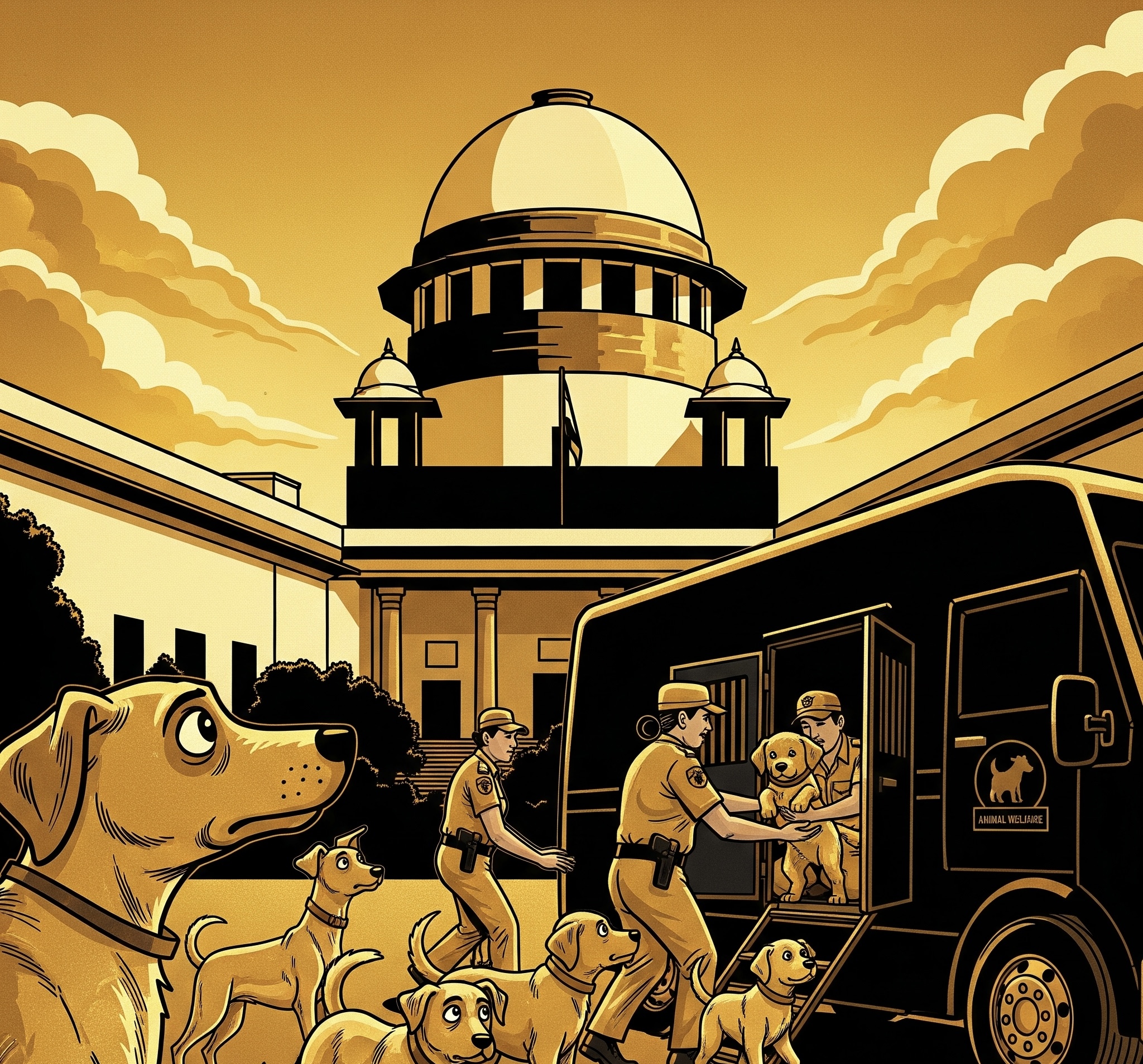
    The Supreme Court has directed authorities in Delhi, Noida, Gurugram, and Ghaziabad to immediately capture stray dogs from all localities and place them in dog shelters, prohibiting their release into public areas. The order came in a suo motu matter concerning the rise in dog bite incidents and rabies-related fatalities. The Court emphasised public safety over sentiment, warning that obstruction of the exercise would invite legal consequences, including contempt.

    Background

    • The suo motu case was initiated after media reports of stray dogs attacking children in Delhi NCR.
    • Solicitor General Tushar Mehta supported strong intervention, stressing that sterilisation alone does not eliminate rabies risk.
    • Amicus Curiae Gaurav Agarwal suggested creating dog shelters; SG pointed to stalled projects due to pending litigation.
    • The Court found existing practice of releasing sterilised dogs back to the same localities “absurd” and ineffective.

    Key Issues

    • Increasing incidents of stray dog bites leading to rabies cases.
    • Lack of adequate shelters and infrastructure to house stray dogs permanently.
    • Ineffective implementation of sterilisation and release programs.
    • Obstructions by individuals/NGOs hindering removal of stray dogs from public spaces.

    1. Public Safety is Paramount

    The Court held that infants and children must be able to move freely without fear of dog bites. “No sentiments should be involved” in this exercise.

    2. Sterilisation Alone is Insufficient

    Even sterilised dogs can transmit rabies; releasing them back endangers public safety.

    3. Authority to Act Decisively

    Authorities are empowered to form special teams, capture stray dogs, and permanently house them in shelters. Any obstruction will invite contempt proceedings.

    Important Observations

    • Existing policy of returning sterilised dogs to the same locality is “unreasonable.”
    • Public health and safety override sentimental or activist objections.
    • Shelters must be properly staffed, monitored via CCTV, and scaled up progressively.
    • Rabies vaccine stock details must be maintained and published.

    This directive reflects the judiciary’s public interest intervention in urban health and safety. It sets a precedent for direct Court oversight in civic issues when administrative measures fail. However, it also raises questions on balancing animal rights and human safety under constitutional frameworks.

    Outcome

    • Delhi, MCD, NDMC, Noida, Ghaziabad, Gurugram authorities ordered to build dog shelters for at least 5,000 dogs within 6–8 weeks.
    • Daily records of captured dogs to be maintained and submitted.
    • No stray dog to be released into the streets once captured.
    • Helpline to be created within 1 week; complaints to be acted upon within 4 hours.
    • Vaccination availability and distribution records to be maintained.

    No Space for Sentiment

    When a trustee of People for Animals sought to intervene, Justice Pardiwala firmly declined:

    “No sentiments in this type of litigation should be involved. We will not allow interventions against the public interest in safety.”

    Suggestions for adoption of captured dogs were also rejected, with the Court cautioning against turning strays into pets “overnight.”

    Final Thoughts

    While the Supreme Court’s ruling adopts a zero-tolerance stance on public safety, it also opens a difficult conversation about balancing human rights with animal welfare. The directive that “no sentiments should be involved” reflects the Court’s urgency in preventing rabies-related deaths, especially among children. However, as a society, we must ensure that the implementation of these directions is humane, ethical, and consistent with animal rights laws. Protecting people and respecting the lives of animals are not mutually exclusive — both require compassion backed by practical, well-planned solutions. The challenge now lies in executing these orders with efficiency, transparency, and humanity.

    Bhavika Singh
    Bhavika Singh

    Supreme Court: Entire Appeal Abates If Legal Heirs of Deceased Party in Joint Decree Not Substituted
    08
    Aug

    Supreme Court: Entire Appeal Abates If Legal Heirs of Deceased Party in Joint Decree Not Substituted

    Case: Suresh Chandra (Deceased) through LRs & Ors. v. Parasram & Ors.
    Court: Supreme Court of India
    Date of Judgment: 18 July 2025
    Coram: Hon’ble Justices P.S. Narasimha and Manoj Misra
    Citation: 2025 LiveLaw (SC) 728

    Summary

    The Supreme Court held that in cases involving a joint and indivisible decree, failure to substitute the legal representatives of a deceased party in time leads to complete abatement of the appeal under Order XXII Rule 3 of the Code of Civil Procedure (CPC). The Court explained that continuing the appeal only against the surviving parties would risk conflicting or inconsistent decrees, which is impermissible.

    Background

    • The original suit was filed in 1983 by Parasram seeking declaration of ownership, possession, and mesne profits of a house.
    • The defendants, Suresh Chandra and Ram Babu, denied the tenancy claim and jointly asserted ownership through inheritance from their father via a 1947 partition.
    • The Trial Court dismissed the suit, but the First Appellate Court reversed it in favour of the plaintiff.
    • A second appeal was filed by Suresh Chandra’s LRs and Ram Babu.
    • During the pendency of the appeal, Ram Babu passed away in 2015, and his legal heirs were not substituted.
    • In 2022, the High Court declared the entire second appeal abated due to this lapse.
    • The LRs of Suresh Chandra appealed to the Supreme Court.

    Key Arguments

    • The appellants argued that the appeal should not have abated in its entirety and could have proceeded against the surviving defendant.
    • They contended that the rights and liabilities were severable between the two defendants.

    Supreme Court Findings

    1. Appeal Cannot Be Partially Continued

    The Court ruled that the decree passed by the First Appellate Court was joint and inseparable, based on a common claim of ownership by both defendants. Therefore, the appeal could not proceed only against one, as it would lead to an inconsistent decree.

    2. Finality of Decree Against Deceased Party

    Once legal representatives of Ram Babu were not brought on record, the decree against him attained finality, and further proceedings would result in conflicting outcomes.

    3. Abatement Applies to Entire Appeal

    In such joint and indivisible claims, abatement in respect of one party is fatal to the entire appeal.


    Cited Precedents

    • Sardar Amarjit Singh Kalra (Dead) by LRs v. Pramod Gupta (Smt.) (Dead) by LRs, (2003) 3 SCC 272
    • Other key legal principles drawn from Order XXII Rule 3 of CPC

    Important Observations

    • The nature of the decree (whether joint and inseverable or severable) is key to determining the effect of non-substitution of LRs.
    • A joint claim based on shared ownership or right, if decreed against the defendants collectively, leads to indivisibility of the decree.
    • Inconsistent decrees are those that are mutually self-destructive, where the enforcement of one negates the other.
    • Courts must avoid scenarios where finality of part of a judgment compromises the fairness and enforceability of the rest.

    This judgment has significant implications for civil appellate practice. It reiterates the importance of promptly substituting legal heirs, particularly in joint decree matters. Litigants and lawyers alike must appreciate the procedural rigour involved in maintaining appeals. A lapse as simple as non-substitution can undo years of litigation, even if the merits favour the appellant.

    Outcome

    The Supreme Court upheld the High Court’s decision and dismissed the appeal in its entirety, citing the risk of inconsistent and unenforceable decrees.

    Final Thoughts

    This ruling will be crucial for civil litigators, estate lawyers, and parties in joint ownership disputes. It reinforces the finality and integrity of joint decrees and the vital importance of procedural compliance in substitution of legal representatives. Failure to act promptly can result in complete abatement and loss of appellate remedies, regardless of the strength of the claim.

    SOURCE: LiveLaw

    Bhavika Singh

    Bhavika Singh